
Union County Parole and Probation
North Carolina uses three community-supervision terms that are easy to confuse. Probation is ordered by a court, often instead of an active prison sentence. Parole is a discretionary early release route for people who remain eligible under older sentencing law. Post-release supervision, often shortened to PRS, is the mandatory period that follows confinement for many people sentenced under Structured Sentencing. A person on any of these statuses may be living in Union County, but the legal source and timing differ.
Parole and PRS show that prison confinement ended while legal supervision continued. Probation does not prove that the person was ever released from prison. It may begin after a suspended sentence, which is a prison term the court does not activate while the person meets probation conditions. The public record should therefore be read for its named status rather than treated as a general release label.
| Status | How it starts | What it says about release |
|---|---|---|
| Probation | A court orders community supervision. | It may occur without prior prison custody. |
| Parole | The Parole Commission approves release in an eligible older-law case. | Prison custody ends, but supervision and the sentence continue. |
| Post-release supervision | State law requires a supervision period after prison. | The person left confinement for supervised community status. |
- Discharge
- The legal end of a supervision term, not merely the day prison custody ended.
- Absconder
- A supervised person whom DAC reports has avoided supervision and cannot be located.
- Detainer
- A request or hold from another authority that may prevent a community release.
Check Union County Supervision Status
The official public lookup is NC DAC Offender Public Information, commonly called OPI. Its status choices include All, Active Inmate, Active Probationer/Parolee, and Inactive. For this task, Active Probationer/Parolee is the useful starting filter. An active community status is distinct from Active Inmate, which DAC defines as a person currently serving a sentence in a state prison.
Use the offender number when it is known. DAC describes that number as the simplest route to one person, and leading zeroes are not required. With no number, combine first and last name with a birth date, age, or other offered details. All supplied criteria must match, so remove a doubtful field if an exact search returns nothing. Never select a record by name alone when several people match.
- Open OPI and select Active Probationer/Parolee, or All if the expected status is uncertain.
- Enter the offender number. If unavailable, use a narrow name search and lawful identity details.
- Open the matching record only after checking the identifier and personal details.
- Read Probation/Parole/Post Release Status, then note Current Location and all begin or end dates.
- Record the offender number before calling the local office about a status the public record does not explain.
Current Location can mean the county of supervision for a person in the community. It should not be read automatically as a jail or prison address. OPI also does not promise a named officer in the public fields. The Union office can route a valid status question when the record shows supervision but not the responsible office.
Union County Supervision Office Route
Union County belongs to Community Supervision Judicial District 20 with Anson, Richmond, and Stanly counties. The DAC office directory lists the Union and district office in Monroe. This is the local route for current-office questions that OPI does not answer. Manager names may change, so the address and main phone lines are more stable routing details.
NCDAC Community Supervision, District 202202-D West Roosevelt Boulevard
Monroe, NC 28110
704-289-6932 or 704-289-6936
Fax: 704-289-4559
Have the offender number and the exact public status ready. Ask whether the Monroe office is the current routing office and what public process applies to the question. Do not expect staff to disclose private case notes or personal officer details. For state-level routing, the Division of Community Supervision is at 2020 Yonkers Road, MSC 4250, Raleigh, NC 27699-4250, and its central number is 919-716-3100.
Record boundary: A community-supervision location identifies the county handling supervision. It does not establish where a person lives or prove that every custody hold has ended.
Union County Absconder Record Check
An active supervision record and an absconder record are not opposites. DAC defines an absconder as a person under community supervision who has avoided supervision and cannot be located. That status means supervision has not ended. A county wanted list may describe another warrant, so it cannot stand in for the DAC supervision record.
The official Absconded Probationer Search accepts a last name, an optional sounds-like search, and County of Supervision. Search Union as the supervision county, then reconcile any result with the offender number and OPI record. A sounds-like search can help with spelling, but it increases the need for identity checks.
The screen below is the successful manifest capture suited to this parole and probation page. It shows the official search channel rather than a county warrant substitute.
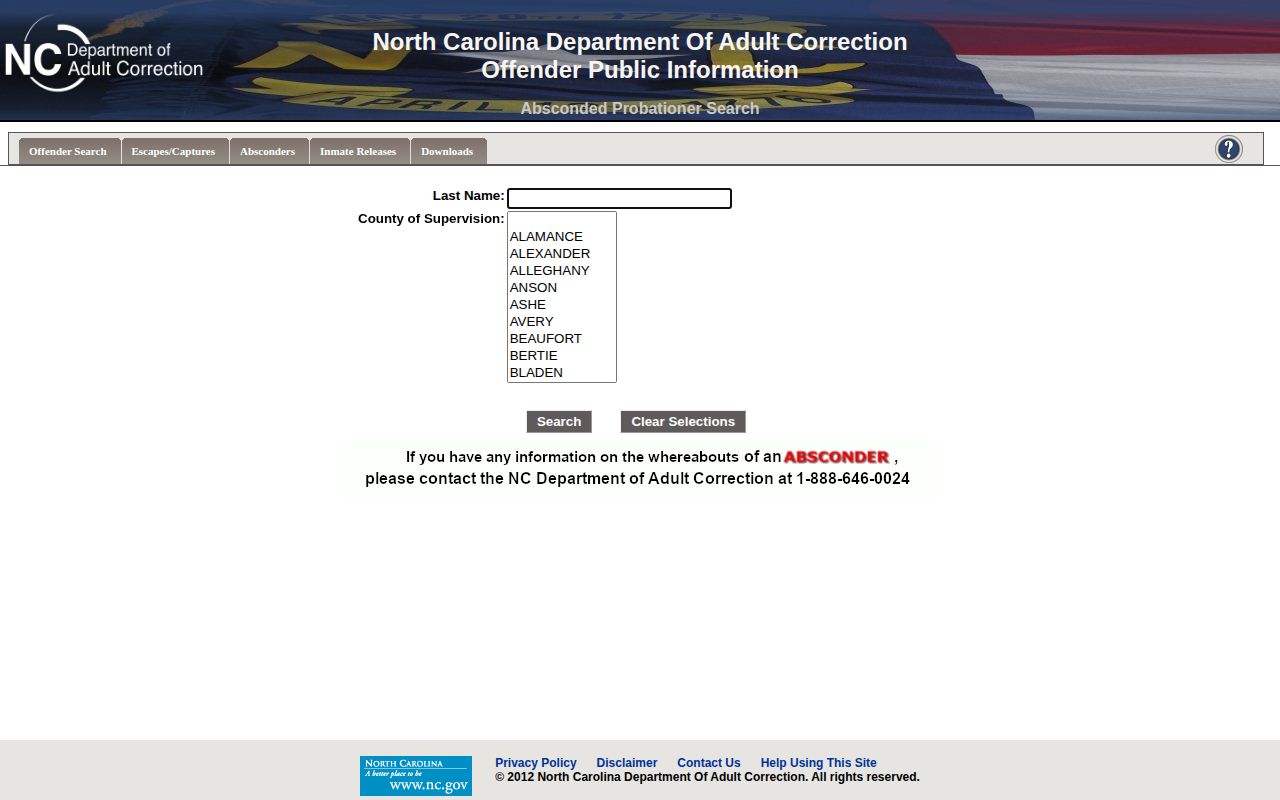
The image supports the search steps, but a live result and DAC confirmation remain the current source. Save the observation date because supervision data can change.
North Carolina Parole File Review
The North Carolina Post-Release Supervision and Parole Commission does not hold formal offender hearings or meet personally with offenders when it reviews parole. Commissioners examine files individually, and a majority must approve or deny parole. That makes North Carolina different from states with public hearing calendars. No conventional Union County parole hearing date or county results calendar should be expected.
Parole generally concerns offenses committed before October 1, 1994. Structured Sentencing removed discretionary parole for later offenses and instead uses mandatory PRS after confinement. Under G.S. 15A-1371, eligibility is a threshold for review, not a promise of release. The Commission may approve or deny an eligible case, sometimes after further investigation, and denial reasons are confidential.
For a named person, OPI may show Parole Begin Date, Parole End Date, status, and movement. Properly available case information can be requested from the Commission at 919-716-3010 or Parole.Commission@dac.nc.gov. Its media notices are not a full person-by-person results database. Separate scheduled input meetings described for victims are not public offender hearings.
The Commission reviews eligible cases at least annually after eligibility, subject to the stated exceptions for certain murder and sexually violent offense categories. Under G.S. 15A-1371, the general eligibility calculation uses the minimum term or one-fifth of the maximum allowed by law, whichever is less, after identified credits. The statute also has special treatment for some Fair Sentencing Class D through J cases after at least 20 years less credits. These rules describe when review may begin. They do not supply a release date.
Commission refusal considerations include risk that the person will not comply, whether release would depreciate the seriousness of the offense, whether continued treatment or training may help, and risk of further conduct. Public OPI dates should be used to see the recorded outcome and movement. If a status has not changed, do not infer approval from eligibility or from the fact that a review occurred.
Union County Supervision and Discharge
A release from prison and a discharge from supervision are two separate events. A Parole Begin Date or PRS begin event can mark the move from confinement to community supervision. The later end date, inactive status, or discharge event addresses the close of supervision. Calling the first date a complete sentence discharge would erase the continuing legal status.
Conditions are set by the court, Commission, and supervising authority for the individual case. A violation can lead to added action, revocation proceedings, or a return to custody, but the public OPI entry must be read before drawing a conclusion. A new jail booking is also a new custody event. The Union County released-inmate search and records path is the right place to verify a separate jail release rather than carrying an earlier supervision date forward.
To confirm that supervision ended, look for inactive Probation/Parole/Post Release Status and relevant end dates or event history. Then contact DAC if the public fields conflict or remain unclear. NC SAVAN, also called VINELink, can report some custody changes, but it is not a substitute for the DAC supervision record or a formal discharge record.
Union County Reentry After Release
Supervision verification and reentry help use different channels. NCDAC lists the Anson/Union County Local Reentry Council with current contacts in its statewide council directory. The Union resource directory also lists SCREEN, the Second Chance Reentry Network, at the Union County Jail. SCREEN’s listed number is 704-283-3573.
These programs may help a person navigate services after release, but they are not custody-status or supervision databases. Contact details should be checked through the NCDAC local reentry council directory because named contacts and program availability can change. Use OPI and the Monroe supervision office for legal status. Use reentry contacts for service navigation.
The separation also protects record accuracy. A program may know that someone asked for help, yet that does not establish parole, probation, PRS, an absconder status, or discharge. Likewise, an OPI community status does not show which reentry service a person uses. Keep service requests with the service provider and supervision questions with DAC.
Keep the roles separate: A reentry program can help with a transition, while only the supervising agency and official record can verify parole, probation, PRS, or discharge.