
Union County Projected Versus Actual Release
The exact NC DAC Offender Public Information label is Projected Release Date. It appears in the Most Recent Incarceration Summary and may also appear in sentence history. The field answers a limited question: based on the current sentence data and credit calculation, what date does the record presently project? It is not an exit confirmation.
An Actual Release Date, read with an inactive incarceration status, sentence service status, and a last movement that represents release or expiration, is stronger evidence that DAC recorded the exit. A released record can show both dates. If they differ, keep each label and date intact instead of replacing one with the other.
Scheduled versus actual: A projected date can change. Confirm the completed event with Actual Release Date, Last Movement, and the releasing agency’s record.
A Union County jail detainee who has not been sentenced has no fixed release date. A bond amount shows what the court ordered, but it does not prove that conditions were met. A dismissal, time-served order, transfer, detainer, or later court action can also change the path without creating a state projected-date field.
Find Union County Projected Release Dates
Start by determining who holds the person. State prisoners belong in NC DAC Offender Public Information, or OPI. A Union jail booking that never became an NCDAC prison sentence may not appear there. For a local jail sentence, ask the jail records route for the applicable calculation and inspect the Union court judgment for sentence terms and credit for time served.
- Search OPI by offender number when available. DAC says the number is the simplest route, and leading zeroes are not required.
- With no number, combine name with birth date, age, or another offered detail, then reconcile the person before opening the record.
- Read Inmate Status and the Most Recent Incarceration Summary, including minimum and maximum terms, Current Location, Last Movement, and Projected Release Date.
- Inspect sentence history for Actual Release Date, Service Status, concurrent or consecutive terms, and other dates that explain the calculation.
- Identify whether Structured Sentencing, older parole law, a local sentence, or another system applies. Do not use one rule for all cases.
- After the event, return to the record and confirm the actual date and movement instead of leaving the projection as the answer.
Write down the date and the day it was observed. OPI can change when DAC receives a court correction, applies credits, or records another sentence event. The observation date makes clear that the figure was a point-in-time projection.
Union County Structured Sentencing Dates
North Carolina Structured Sentencing uses a minimum and maximum term. G.S. 15A-1340.13(c) requires the judgment to state both terms. Subsection (d) requires a person with an active punishment to serve the minimum. Earned time may reduce the maximum, but it cannot reduce the term below that minimum.
NCDAC’s parole-process summary describes offenses committed on or after October 1, 1994 as requiring 100 percent of the minimum and 85 percent of the maximum, followed by post-release supervision where applicable. That does not mean every person simply “serves 85 percent.” The mandatory minimum, maximum, PRS design, credits, offense class, offense date, and sentence history all matter. A county jail booking, an older parole-eligible sentence, and a federal sentence cannot be put into that shorthand.
The Structured Sentencing statute shown in the manifest capture is the primary source for the minimum and maximum framework.
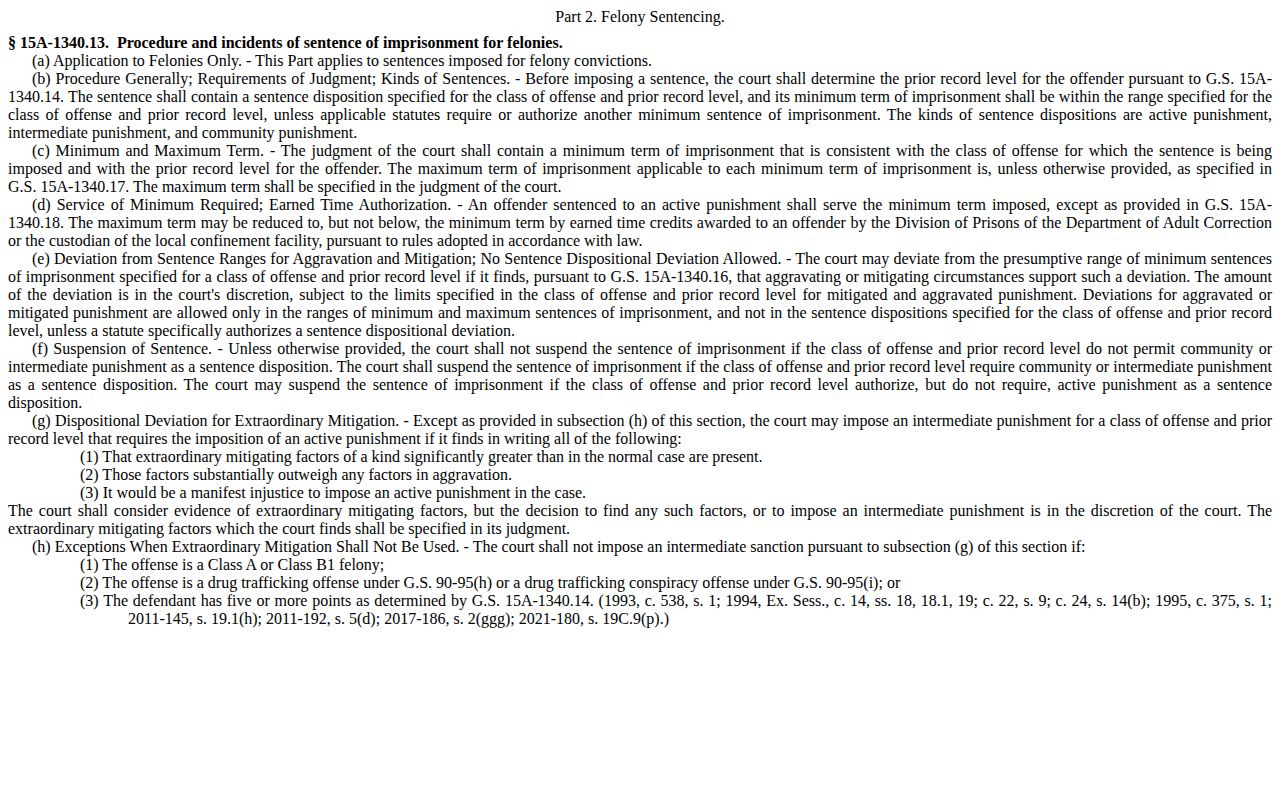
The screenshot supports the statutory framework. The signed judgment and individual DAC record still control the person-specific calculation.
Union County Earned-Time Release Rules
Earned time is a credit governed by correctional rules and an individual’s sentence and conduct. G.S. 148-13(a1) requires DAC rules for earning and forfeiting time on activated felony and misdemeanor sentences. Subsection (e) requires local jail administrators to follow distributed earned-time and good-time regulations for sentenced jail prisoners.
The statute does not publish one universal daily credit rate for every Union County prisoner. A person may have a different sentence type, credit history, disciplinary record, or calculation under the rules that apply to the sentence. For a DAC prison term, use the individual OPI projection and ask DAC about a discrepancy. For a sentenced county jail term, request the applicable jail calculation rather than using an online date calculator.
The North Carolina earned-time statute captured for this project shows why credits must be traced to the governing rule.
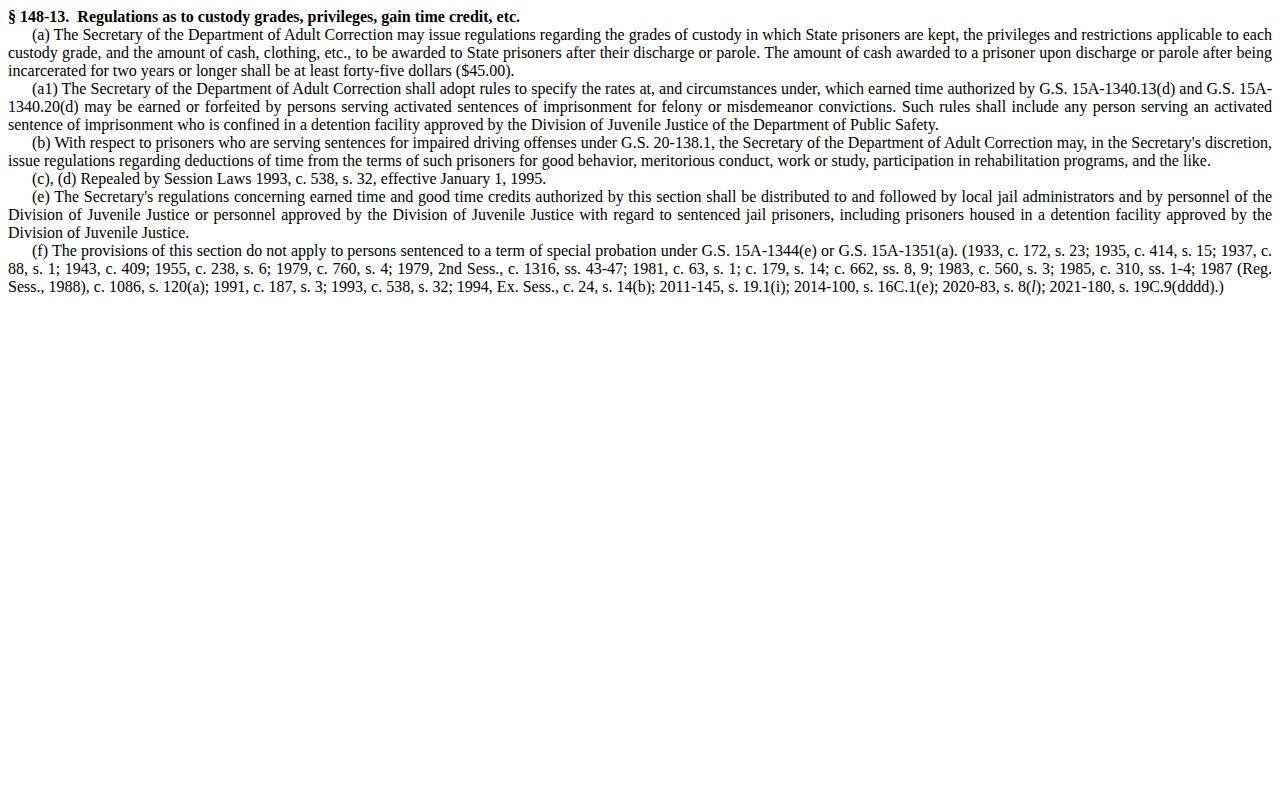
Use the statute to understand the authority for credits and forfeitures, not to invent a person-specific number that the public record does not supply.
Union County Post-Release Date Rules
Release from confinement to post-release supervision is not an unconditional sentence discharge. G.S. 15A-1368.2 governs the post-release date. In general terms, it calculates that date from the maximum imposed term less the applicable statutory period and earned time. The statute uses different amounts for groups of felony classes, including a 12-month amount for B1 through E felonies, nine months for F through I felonies, and a 60-month amount for the referenced maximum under G.S. 15A-1340.17(f).
Those figures cannot be applied without the offense class, judgment, offense date, sentence structure, and current credit record. Multiple sentences may be aggregated or may run concurrently or consecutively. PRS begins legal community supervision. The projected transition out of prison therefore may precede the date the whole sentence and supervision end.
The post-release date statute shown in the successful manifest image is suited to this distinction.
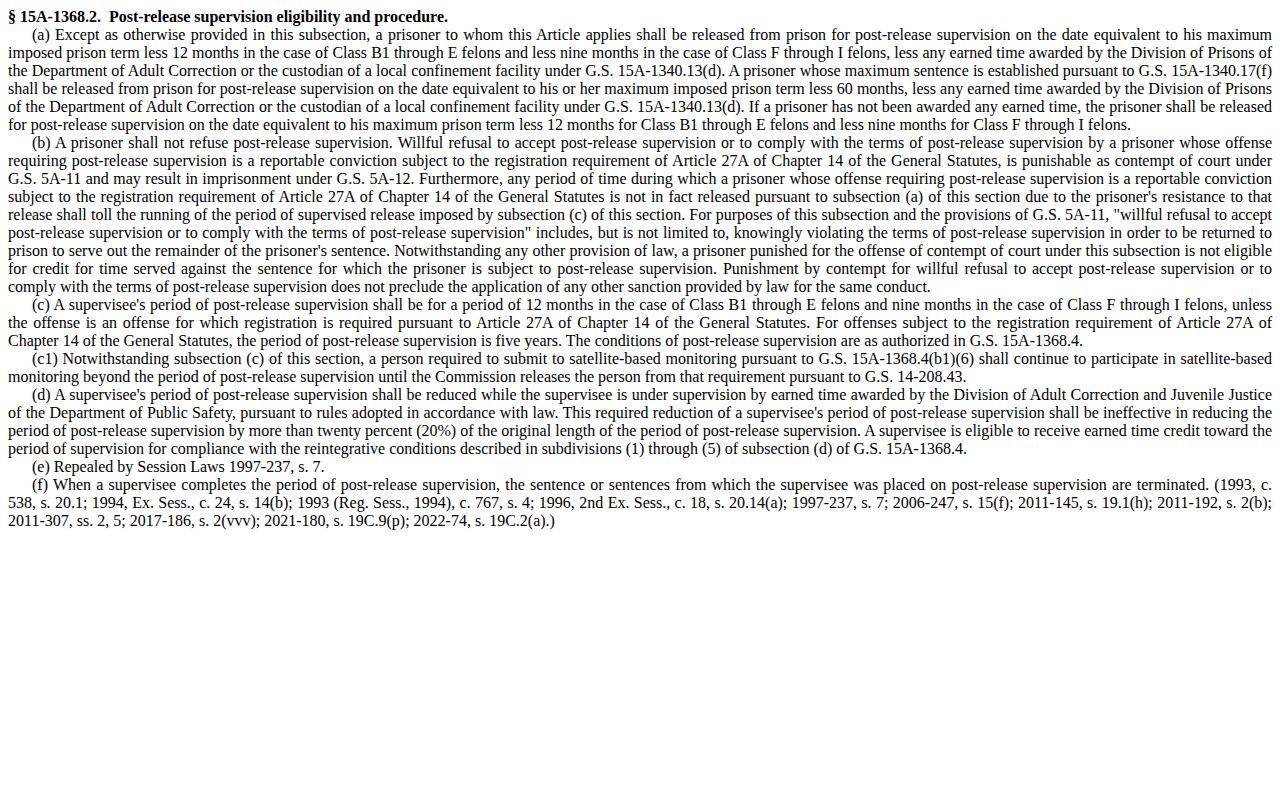
The statutory image explains the legal transition. OPI supplies the current projected date and later actual movement for the individual record.
Why Union County Release Dates Change
A projected date is recalculated as the legal and correctional record changes. The cause may be a routine credit update, a court correction, or another custody obligation. The field alone does not identify which factor moved the date, so inspect sentence history and contact the correct custodian when the reason matters.
| Factor | Possible effect | Confirmation source |
|---|---|---|
| Earned-time award or forfeiture | Moves the current maximum-based calculation within legal limits. | DAC record and applicable credit rules. |
| Disciplinary event | May lead to credit forfeiture under governing rules. | Correctional record, not a generic calculator. |
| Court correction or new order | Changes terms, credit, or the legal basis for custody. | Signed judgment and updated DAC or jail record. |
| Concurrent or consecutive sentences | Changes how terms combine and which term controls. | Sentence history and judgment. |
| Detainer or other hold | May prevent community release after one term ends. | Current and receiving custodians. |
| Eligible older-law parole | May allow release before a projected maximum-based date. | OPI dates and Parole Commission information. |
A county release can also depend on satisfaction of bond terms and administrative processing. A next court date or bond amount provides context but is not a physical discharge time. When another agency takes custody, the movement is a transfer even if the person has left the Union jail.
Union County Pretrial Release Dates
A pretrial detainee has not received a sentence calculation, so there is no NCDAC projected release date to compute. The court may set conditions for release, modify bond, dismiss a charge, or later enter judgment. Each action can affect legal custody, but none alone proves the time the jail completed discharge. The physical event belongs in the Union jail Release Date field or agency record.
A secured bond amount is a condition, not a countdown. The person must meet the terms, the jail must process the release, and any detainer or other hold must be resolved. A next court date also describes the pending case rather than custody status. If the Union roster entry disappears, the person may have been released, transferred to overflow custody, committed to NCDAC, or moved under another agency’s hold.
Use the court file to explain authority and the custodian record to confirm movement. The Union County Judicial Center can provide case documents for Union matters, and the Sheriff’s P2C detail can expose the event Release Date while it remains available. If the live detail is gone, request the existing booking and release record. Do not create a projected date from the bond order or hearing schedule.
Separate Union County Release Events
A Union County Sheriff’s Office account from May 2025 documents a person posting a secured bond shortly after midnight and being arrested again only hours later. The account creates two separate custody episodes. The first release date belongs to the earlier booking. It must not be carried forward as though it proves release from the later arrest.
This local example also shows why a bond decision and an actual release event must remain separate. The order sets the legal terms. The person leaves only after the conditions are met, administrative processing is complete, and no other hold prevents release. A later arrest begins a new booking, with a new status and potentially different release route.
Keep an event-level record: booking or offender number, arrest or admission date, facility, projected date if one exists, actual release date, last movement, and source observation date. The Union County release-record search can be used for the jail event, while OPI remains the durable route for a state-prison sentence.
Confirm Union County Inmate Release Dates
After the projected day arrives, search again. In OPI, read Actual Release Date, Last Movement, Last Movement Date, incarceration status, and service status. A movement that represents release or expiration plus an actual date is far stronger than a projection that simply reached today. If the status remains active, contact DAC before assuming the public screen is late.
Preserve the date checked with the result. That timestamp shows which version of the calculation was observed.
For Union jail custody, request or confirm the event’s Release Date through the Sheriff’s P2C detail or the county record route. Pair the event with the court file when the legal basis matters. The court may show bond, dismissal, judgment, or credit for time served, but the jail record confirms physical discharge. If the person went to another jail or NCDAC, the correct result is transfer, not release to the community.
NC SAVAN can provide a reported custody-change alert, and the Union County VINELink Release Check explains how to register and read the event language. Treat the alert as a prompt to verify. It cannot rule out every other custodian or establish final sentence discharge by itself.